Context has an owner.
The Analyst curates the inputs before drafting begins. The Writer receives a bounded brief instead of being asked to perform every role at once.
HolyCalm Content Engine
A content workflow that gives each agent a defined job: gather the right context, draft within constraints, critique the output, then bring it back to a person.

Workflow architecture · Based on workflow instructions
Each role has a defined input and handoff. Read the sequence below.
Orchestrator
Extract the content type, topic, channel and quantity. The topic selects persona material; brand guidance is always loaded.
Needs: the user’s request.
“If content_type is unclear, ASK before proceeding. Do not guess.”
Source excerpt · Step 1
Required research
The Analyst reads brand guidance and routed personas, extracting relevant language, voice rules and constraints into a brief.
Needs: the request, brand foundation and selected persona files. Can run alongside Context.
“Do NOT write any content yourself. Just extract and organize the raw material.”
Source excerpt · Step 3
Optional research
For pricing, competitor or feature messaging, the Context agent reads market data and selected PRD sections. Other requests skip this role.
Needs: the topic, market material and product documentation. Does not depend on the Analyst’s output.
“Only needed when topic includes price comparison, competitor positioning, or feature-based messaging.”
Source excerpt · Step 3
Generation
The Writer combines the Analyst’s brief with Context output when relevant. It drafts twice the requested quantity so the Critic has candidates to compare.
Needs: Analyst output, plus Context output if that role was required.
“No fake numbers, no fake reviews, no FOMO language”
Source excerpt · Step 4, rule 10
Evaluation
The Critic applies five criteria and explicit rejection rules. It ranks candidates and attaches a suggested improvement to each selection.
Needs: the Writer’s candidates and the supplied brand rules.
“For each selected piece, note 1 specific improvement suggestion”
Source excerpt · Step 5
Return to the conversation
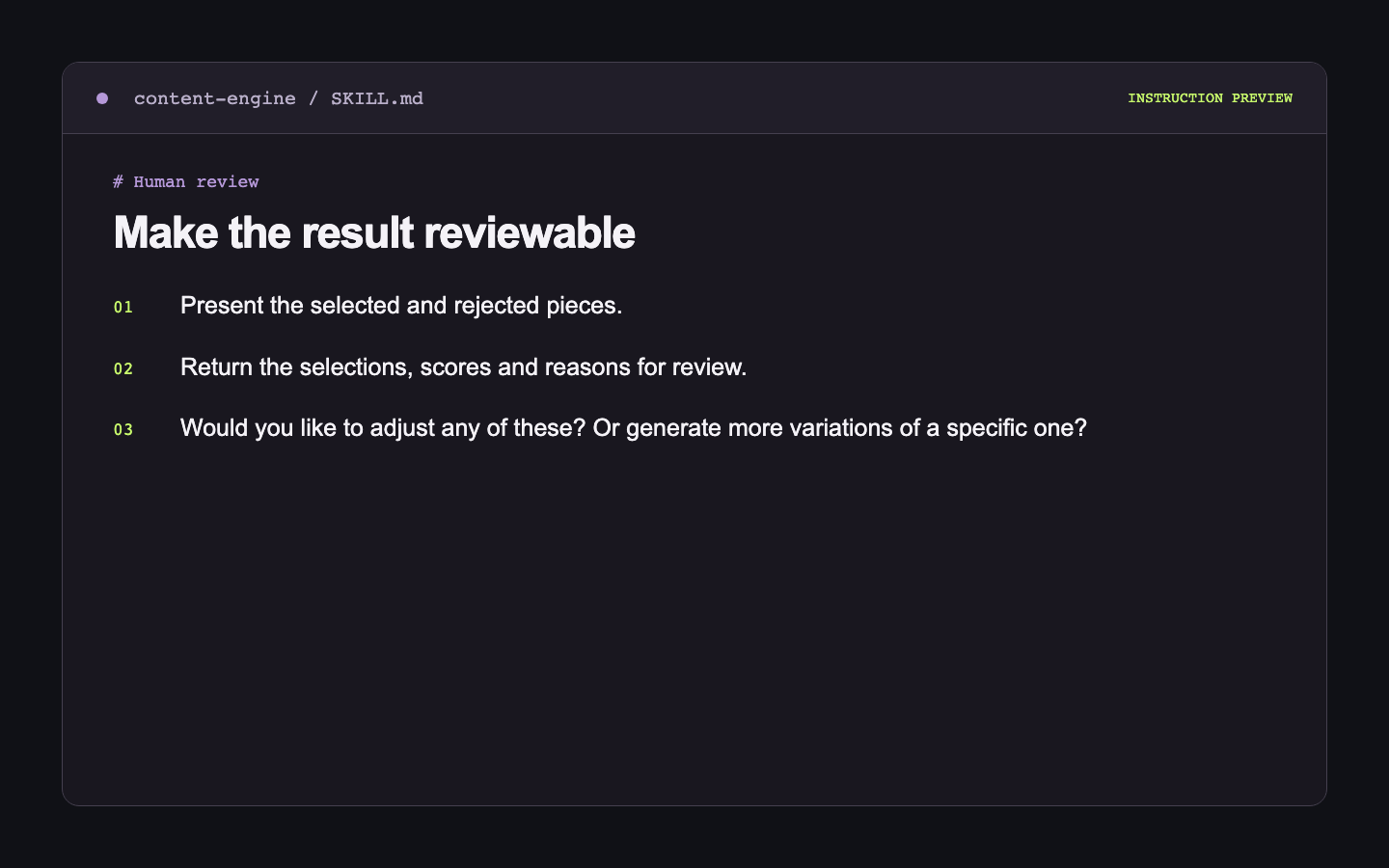
The orchestrator presents the selected and rejected pieces, then invites adjustments. The instructions end with review and revision; they do not specify automatic publishing.
Needs: the Critic’s selections, scores and reasons.
“Would you like to adjust any of these? Or generate more variations of a specific one?”Source excerpt · Step 6
This diagram explores the documented architecture. It does not run agents or display generated content from a recorded execution.
The design work here lives in the instructions: what information enters, which role can act next, and how a person sees the result. HolyCalm’s brand rules and audience research become context for a coordinated drafting and review process.
This is a separate content-production workflow. It does not describe HolyCalm’s in-app experience, meditation audio generation or a chat feature inside the app.
Read the system
The Analyst and optional Context agent can work together. The Writer waits for their briefs. The Critic waits for the draft.
Voice, vocabulary and guardrails
Relevant personas and language
Extract content type, topic, channel and quantity. Route to audience material. Ask if the content type is unclear.
Read the brand and routed personas. Return a concise brief for the Writer.
Output: brand + audience briefRuns for price, competitor or feature messaging. Reads market data and selected PRD sections.
Output: supporting contextWait for the required briefs
Combine the briefs with the requested format. Produce twice the requested quantity for the Critic to filter.
Output: candidate contentApply the rubric and rejection rules, rank candidates, then attach an improvement suggestion to each selection.
Output: selections + rejection reasonsPresent the selections, scores and rejected pieces. Invite adjustments or more variations.
Output: a reviewable result in the conversationContext selection
The brand foundation stays constant. The audience material changes with the request. These routes are excerpts from the documented routing table.
Sleep
Two persona sources inform the brief.
Grief
A focused route for loss and comfort.
Price or comparison
Buyer research and demographics, plus the optional Context agent.
These are research personas named in the instructions, not people interacting with the system or verified audience results.
Inspect the instructions
Open a role to see its inputs, output and a curated excerpt from the source. These are instructions, not transcripts of a successful run.
Inputs: the request, brand foundation and selected persona files.
Output: a brief of up to 500 words with relevant voice rules, audience language and guardrails.
“Do NOT write any content yourself. Just extract and organize the raw material.”
Curated excerpt · SKILL.md · Step 3, Analyst
Inputs: market material and selected PRD sections.
Output: up to 300 words of competitive and product context. It can run alongside the Analyst.
“Only needed when topic includes price comparison, competitor positioning, or feature-based messaging.”
Curated excerpt · SKILL.md · Step 3, Context agent
Inputs: Analyst output, optional Context output and the requested format.
Output: twice the requested number of pieces, with a hook, body, call to action and rationale.
“No fake numbers, no fake reviews, no FOMO language”
Curated excerpt · SKILL.md · Step 4, rule 10
Inputs: candidate content and brand rules.
Output: ranked selections, criterion scores, suggestions and a rejection summary.
“Theological violation → REJECT”
Curated excerpt · SKILL.md · Step 5, rejection rules
Inputs: the Critic’s selection and reasons.
Output: a presentation of selected and rejected content, followed by an invitation to refine.
“Would you like to adjust any of these? Or generate more variations of a specific one?”
Source excerpt · SKILL.md · Step 6
Evaluation design
The Critic is instructed to assess five dimensions. No measured scores or performance gains are represented here.
Does the language fit the brand?
Does it match the selected persona?
Does it begin with the person’s problem?
Is the price framed as instructed?
Does it respect theological constraints?
The instructions reject prohibited vocabulary and theological violations regardless of the total. This makes some constraints explicit, but a model’s judgment still needs human review.
The Analyst curates the inputs before drafting begins. The Writer receives a bounded brief instead of being asked to perform every role at once.
Parallelism is used for independent research. Drafting and critique follow their inputs, making the handoffs easier to inspect.
The person reviewing gets rejection reasons and improvement suggestions alongside the selected content.
A useful evaluation would compare actual drafts, critique decisions and human edits across repeated requests. Does the rubric agree with human judgment? Are source facts current? Which rejected pieces should have survived?
The source describes the intended workflow. It does not provide a benchmark, run history, measured quality improvement or an enforced publishing approval mechanism. Those are separate things to demonstrate.
Source: HolyCalm Content Engine, SKILL.md · Architecture, Steps 1–6 and Performance Tips. This page is a curated explanation of that local instruction file; it does not execute agents.
Inside the workflow