Design exercise
Waiters App
Turn feedback on service into something useful for the person providing it.
01 / 06
Look beyond the restaurant rating
The brief asked for an experience where diners could leave positive comments and constructive suggestions for individual servers. Servers could then use that feedback to improve and support future employment opportunities.
The challenge was to identify a natural moment for useful feedback while reducing the effort involved. Rather than begin with a rating screen, I explored the dining journey and how people already chose, visited and talked about restaurants.
02 / 06
Research the whole dining experience
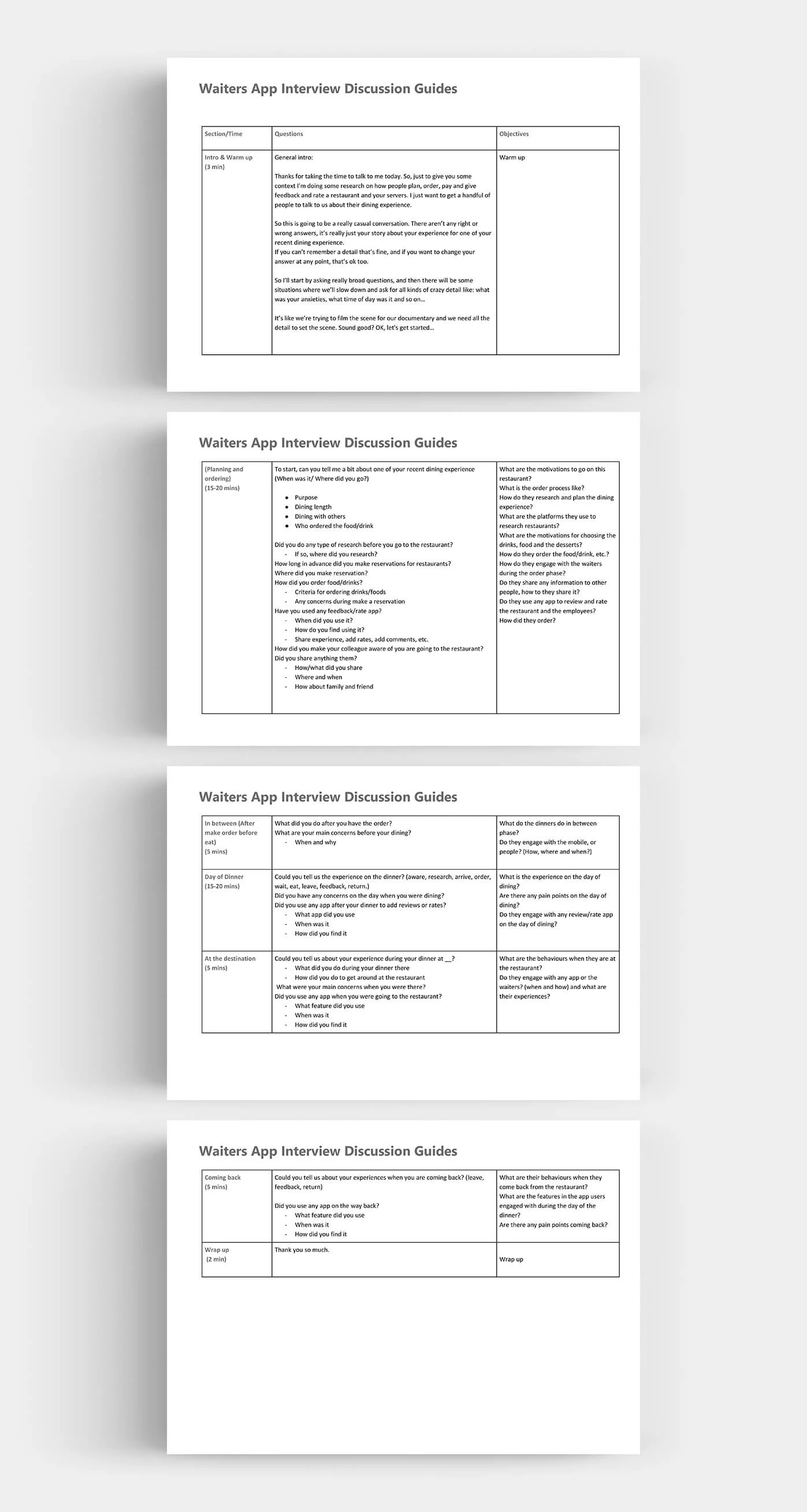
On 31 August 2018, I interviewed four diners. Sessions lasted 45–60 minutes, followed by around 30 minutes of analysis. The participants included two women and two men, aged 32–59, from engineering, IT, sales and healthcare. Two used Android and two used iOS.
The discussion covered planning and booking, ordering, the time between ordering and eating, the experience at the restaurant and what happened afterward. I asked about habits, motivations, use of apps and sharing the experience with others.
This was a small exploratory study. Interviews with servers and restaurant hiring managers remained future work, so the research did not validate every side of the proposed service.
03 / 06
The moment for feedback matters
Participants often returned to familiar restaurants and ordered familiar food and drinks. They were also open to recommendations that could help them try something outside their routine.
Planning and making a reservation were described as enjoyable parts of the experience. TripAdvisor, Yelp and Zomato were commonly used to discover places. Participants wanted to share dining experiences and were willing to give feedback at the end of the service.
That suggested a direction for the product: make feedback available at a moment that already fits the diner’s behaviour, rather than demand attention throughout the meal.
04 / 06
Translate the research into a provisional persona
I began with proto-personas and compared them with the interview findings. One persona, David Maher, represented a parent in Dublin who enjoyed eating out, used mobile technology and liked sharing experiences.
The relevant needs were practical: a simple experience, quick access, a way to identify the person who served him and enough information to leave a useful review. These needs were more useful to the design than treating a generic star rating as the complete solution.
05 / 06
Map behaviours to product requirements
I grouped activities before, during and after the meal into behavioural affinities. That connected the research to possible content, features and tasks the product should support.
The resulting ideas were entered into a spreadsheet and prioritised against persona needs, technical feasibility and business objectives. The intention was to define a first release with a clear purpose, rather than turn every interview observation into a feature.
06 / 06
Define the next design step
The desired outputs were a high-level app schematic, navigation alternatives, concepts for key pages and screen flows connecting the structure to the experience. I considered the trade-offs between a tab bar, a dashboard and a hamburger menu on iOS.
The recovered case is a discovery exercise. It does not contain a validated, shipped app or a completed high-fidelity solution. The next work identified in the original reflection was deeper exploration of wireframes, scenarios, flows and micro-interactions, alongside testing more assumptions.
- Interview servers and hiring managers to understand their side of the service.
- Test how diners identify the correct server and leave constructive feedback.
- Develop and compare navigation and screen-flow options.
- Validate the proposed first-release scope.